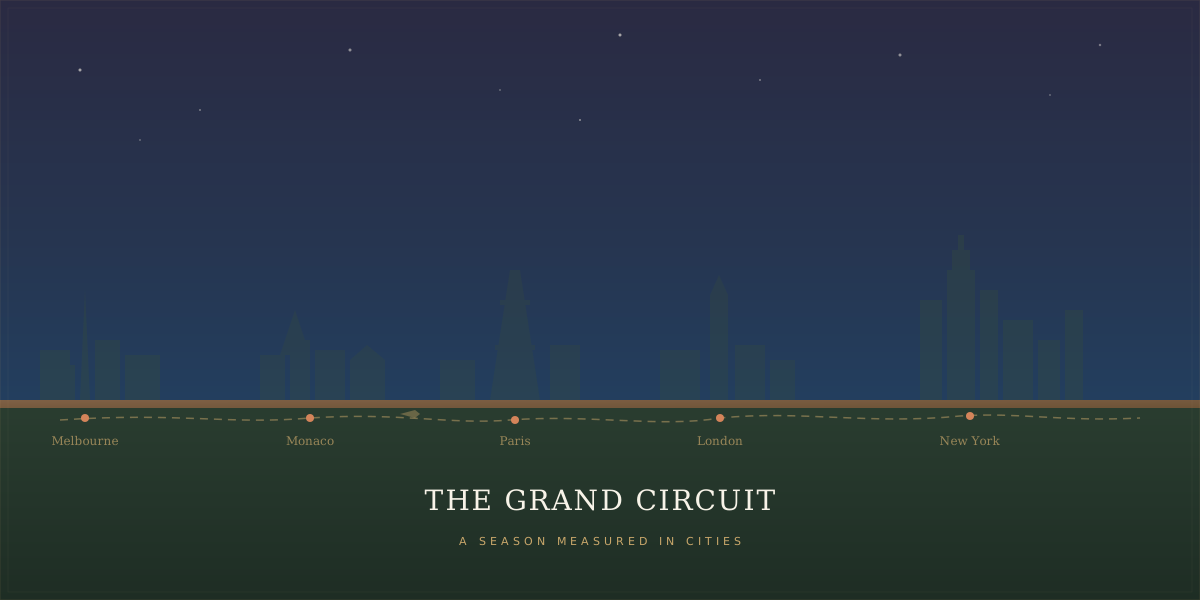
There is a calendar that exists outside the ones published by the ATP, the FIA, FIFA, or the IOC. It is not organized by rankings or qualification rounds. It is organized by cities, by seasons, by the rhythm of travel that connects the world's greatest sporting events into a single, continuous experience.
Melbourne in January. Monaco in late May. Paris in early June. Silverstone in July. New York in late August. And woven between them, the Formula 1 grid traces its own arc across five continents — twenty-four races from Bahrain to Abu Dhabi, each one a traveling spectacle of speed, fashion, and engineered elegance. Every four years, the World Cup and the Olympics add new cities to the rotation. This is the grand circuit. Not a league. Not a tour. A way of experiencing the world through its most significant sporting moments.
The 2026 Season
This year's circuit begins where the global sports calendar always begins — in Melbourne, in the heat of the Australian summer. The Australian Open is the Grand Slam that sets the tone. Melbourne Park sits at the intersection of sport and city culture in a way no other venue does: world-class coffee on every corner, street art lining the laneways, and an energy that is equal parts relaxed and electric. The night sessions under the Rod Laver Arena roof have become some of the most coveted tickets in world tennis.
From Melbourne, the circuit shifts gears — literally. The Formula 1 season fires up across the globe: Bahrain under floodlights, then Jeddah, then Melbourne again for the Australian Grand Prix in March, the city doing double duty as both a tennis and motorsport capital. By May, the F1 paddock arrives in Monaco — the race that is less about speed and more about being seen. The yachts in the harbor, the champagne on the terraces, the fashion in the pit lane. Monaco is where Formula 1 and luxury culture become indistinguishable.
Then Paris. The red clay of Roland-Garros in late May is not just the start of the Grand Slam summer. It is the event that sets the cultural tone for everything that follows — the fashion, the hospitality, the energy of a city that treats sport as an extension of art.
From Paris, the circuit moves to London for Wimbledon — where tradition meets precision and the all-white dress code transforms the grounds into a moving editorial. Silverstone follows just days later, the British Grand Prix offering a counterpoint to Wimbledon's restraint with raw speed and roaring grandstands. Then to New York for the US Open, where the night sessions at Arthur Ashe Stadium offer an atmosphere unlike anything else in sport — and the city itself becomes the event.
And threading through it all, the FIFA World Cup 2026 — hosted across the United States, Canada, and Mexico — the largest World Cup in history, spanning three nations and sixteen cities. While the F1 grid races on in parallel: Monza in September, Singapore under lights in October, and the season finale in Abu Dhabi in December.
The grand circuit is not about who wins. It is about what it feels like to be there — from the pit lane in Monaco to the red clay in Paris.
A New Way to Cover Sport
Traditional sports media follows the ball — or the car. Grand Circuit follows the experience. We cover the architecture of the stadiums and the paddock, the design of the hospitality spaces, the fashion in the stands and the grid, the business deals being signed in the suites, and the cultural identity of every city that hosts these events.
Every event on the grand circuit — from the Grand Slams to Formula 1, from the World Cup to the Olympics — shares something essential: they are not just competitions. They are gatherings. Melbourne gathers the world in January. Monaco gathers it in May. Paris in June. New York in September. The story of those gatherings — who comes, what they wear, how they celebrate, and what it means to them — is the story that Grand Circuit was built to tell.